Build a Safer Balance Routine at Home
Try four supported balance exercises for older adults, with safer progressions, warning signs, and Las Colinas physical therapist guidance.
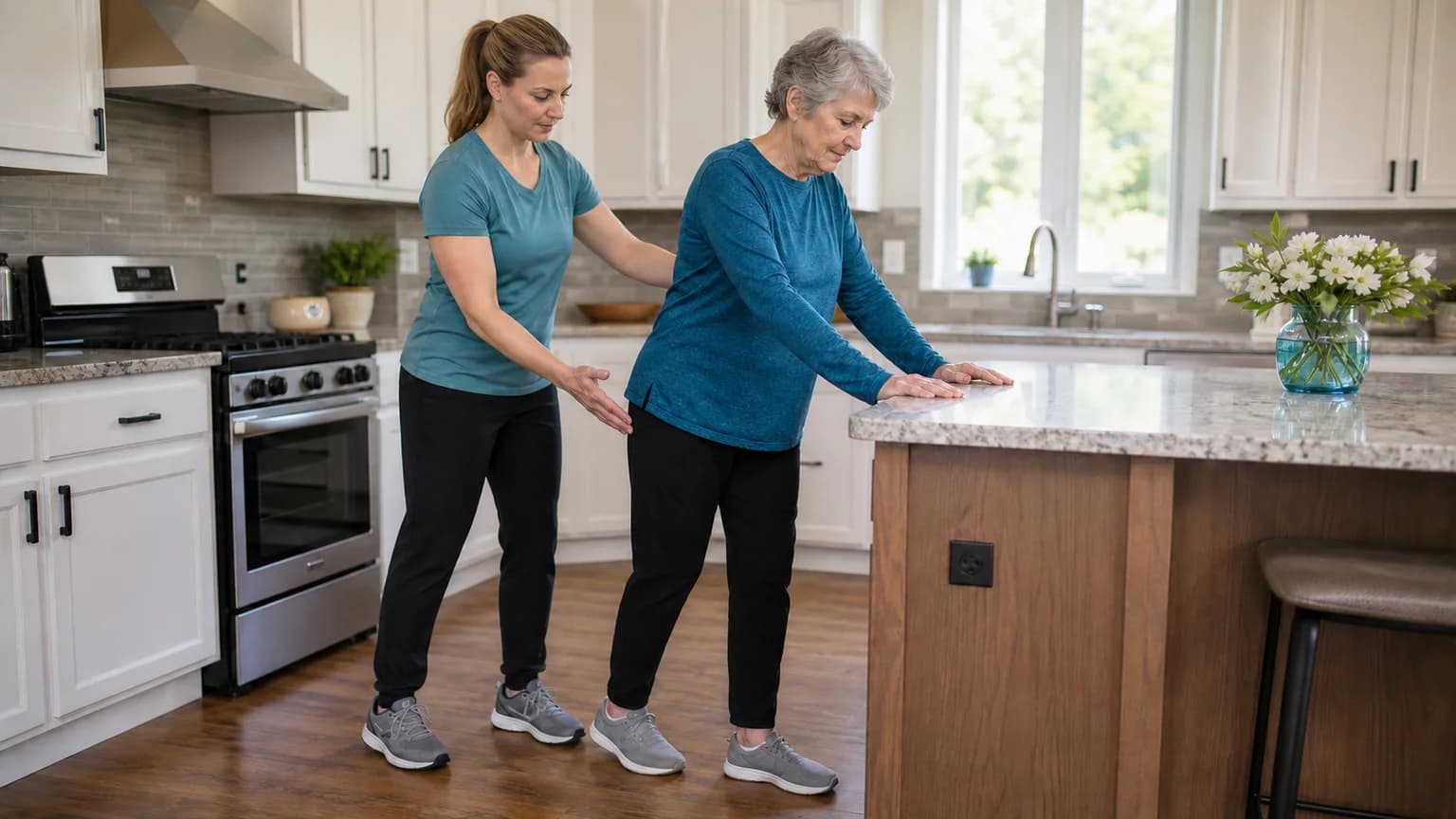
Feeling less steady does not mean moving less. Carefully chosen balance exercises can reduce falls. The key is stable support and an appropriate starting level. This example is not a complete fall-prevention program or a substitute for assessment. A systematic review found that balance and functional exercise reduced fall rates in adults age 60 and older. Read the falls-prevention systematic review.
Before you start
Set up beside a fixed countertop or railing. If using a chair, choose a non-wheeled chair braced against a wall. Wear nonslip shoes and clear rugs, cords, clutter, and pets from a dry, well-lit floor. Keep a phone nearby and ask an adult to stay if your balance is unpredictable.
Do not begin alone after a recent fall, if you need a cane or walker to stand, cannot stand safely without pulling up, or have unexplained dizziness, fainting, leg buckling, recent surgery, or a new neurologic, vision, or inner-ear problem. NICE falls guidance emphasizes matching exercise to the person's abilities and fall risk.
Stop for dizziness, increasing pain, unusual shortness of breath, or a near-fall. End the set before movement becomes hurried or you grab for support.
1. Sit-to-stand
Set up
Sit near the front of a chair braced against a wall. Place both feet flat, hip-width apart, with the countertop within reach if needed.
Do
Lean forward slightly, press through both feet, and stand. Pause, then lower slowly. Use your hands as needed for control.
Start with
Try 1 set of 5–8 repetitions. This is an example starting dose, not a universal prescription.
Make it harder
Add repetitions, slow the lowering, or use slightly less hand pressure. Do not lower the chair. Progress only after at least a few practice sessions with smooth repetitions, no unusual shortness of breath, and no recovery step.
This trains the leg control used for chairs, toilets, and transfers.
2. Supported tandem stance
Set up
Face a fixed countertop with both hands available. Place one foot slightly ahead of the other; full heel-to-toe alignment is optional.
Do
Stand tall and keep equal pressure through both feet. Use enough fingertip or hand support to remain steady. Switch which foot is in front.
Start with
Hold for 10–20 seconds on each side and repeat 3 times.
Make it harder
Narrow your stance or add 5 seconds while keeping support. Do not close your eyes, turn your head, use an unstable surface, or remove support unless a clinician approves it. The CDC fall-intervention compendium includes staged home-program examples with exercises such as sit-to-stand.
3. Supported weight shifts
Set up
Stand at the countertop with your feet comfortably apart and both hands close to support.
Do
Shift toward one foot without lifting either foot. Return to center and shift to the other side. Stay upright with relaxed knees.
Start with
Try 5–10 controlled shifts in each direction.
Make it harder
Increase the shift slightly while keeping both feet planted. A clean repetition ends with control—without grabbing, crossing your feet, or taking several steps to recover.
A useful quality check is control: reach only as far as you can shift and return without grabbing or stepping. More distance is not automatically better.
4. Counter-supported stepping
Set up
Stand within fingertip reach of a fixed counter. Make sure the floor is clear in front of you and to each side.
Do
Place one foot a short distance forward, return it, then step to the side. Move one foot at a time. Practice backward or rapid steps only with a clinician or capable spotter who has assessed you.
Start with
Try 5 steps forward and 5 steps to the side with each foot.
Make it harder
Add repetitions before increasing distance. Stop if your feet cross, steps become hurried, or you pull hard on the counter. Structured stepping programs improved several fall-risk factors in older adults, but they were not one universal home prescription. Read the step-training review.
How often should you practice?
Start with 2–3 short sessions weekly if tolerated. Effective programs may build toward more weekly balance and functional exercise, but volume should increase gradually and may require supervision.
When should you get help?
Call 911 for sudden weakness or numbness, facial drooping, trouble speaking, chest pain, fainting, or severe unexplained shortness of breath. These are among the warning signs described in MedlinePlus emergency guidance. After a head strike, seek urgent medical evaluation—especially with loss of consciousness, confusion, vomiting, worsening headache, or blood-thinner use. The CDC's adult head-injury danger signs say to call 911 or seek emergency care for a seizure, worsening consciousness, repeated vomiting, new weakness, or other listed danger signs.
Schedule a medical or physical therapy assessment for repeated falls or near-falls, worsening unsteadiness, new dizziness, leg buckling, or a new need to hold furniture. Medication effects, blood-pressure changes, vision, the inner ear, and neurologic or cardiovascular conditions may need evaluation.
Bottom line
A safer balance routine is not a test of toughness. Start with stable support and progress only after the current version is repeatable. If near-falls are frequent, learn what an in-home physical therapy visit in Dallas can assess or contact PT365 about a balance evaluation in Las Colinas.
Clinical References
- Do Exercises Prevent Falls Among Older Adults: Where Are We Now? A Systematic Review
- NICE NG249: Falls—Assessment and Prevention in Older People
- A CDC Compendium of Effective Fall Interventions: What Works for Community-Dwelling Older Adults
- Step Training Improves Reaction Time, Gait and Balance and Reduces Falls in Older People
- Recognizing Medical Emergencies
- Symptoms of Mild TBI and Concussion
Related Headlines
Continue With PT365
Browse direct answers to common patient questions, learn how mobile outpatient physical therapy works, or request an appointment.