The Simple Step-Down Strength Test for Knee Longevity
Learn how the step-down test can reveal knee control, hip strength, and balance issues—and how to build stronger joints for long-term mobility.
The Simple Step-Down Strength Test for Knee Longevity
Most people think about knee health when something starts to hurt: a sore kneecap on stairs, stiffness after sitting, or a sharp reminder during a hike. But one of the best ways to protect your knees is to look at how your body handles a basic daily demand before pain becomes the main signal. One of my favorite screens for this is the step-down.
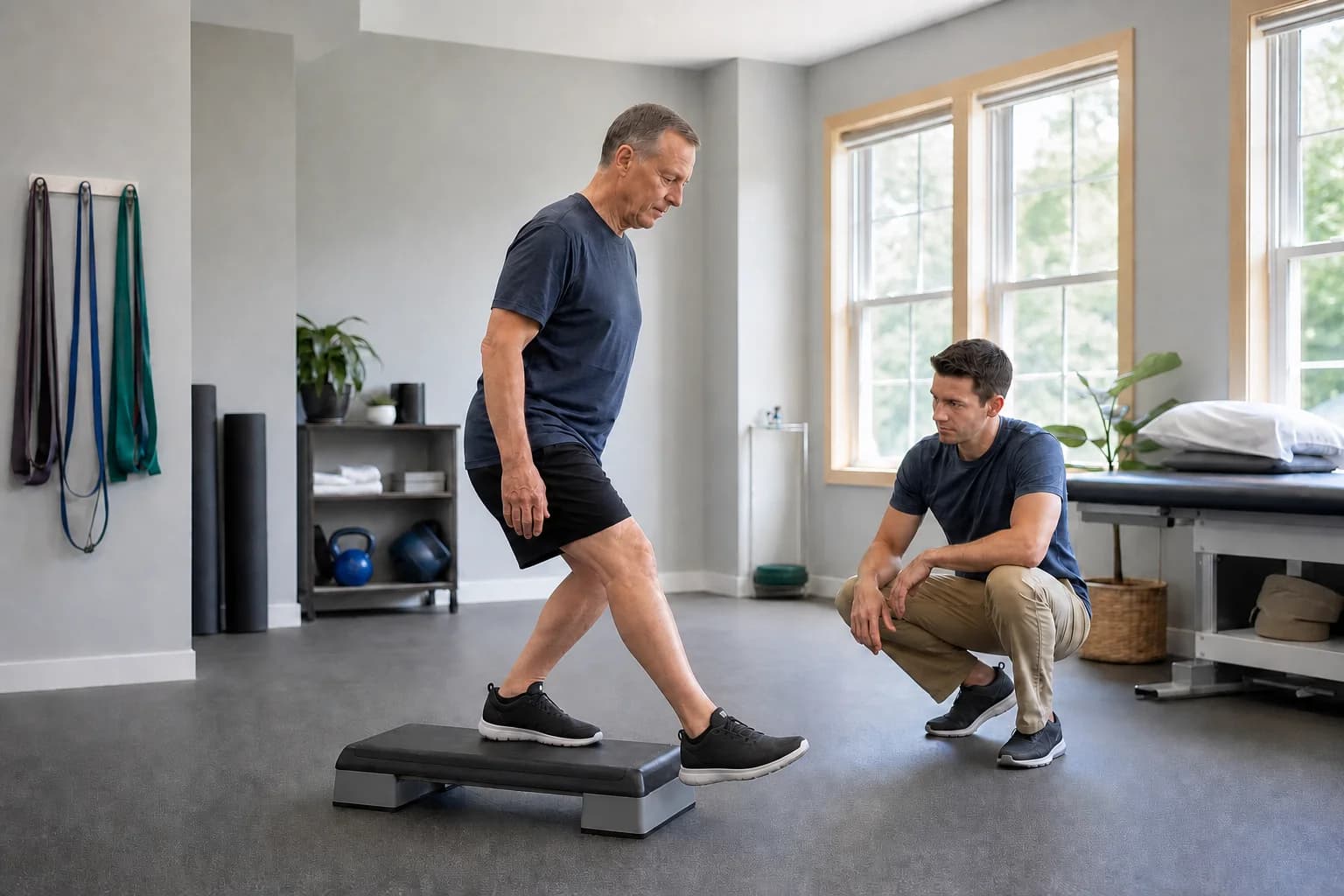
A step-down is exactly what it sounds like: standing on a low step, slowly lowering one foot toward the floor, then returning to the starting position. It looks simple, but it gives a lot of useful information. Your hip has to steady the thigh, your knee has to track over the foot, your ankle has to control motion, and your trunk has to stay balanced. That is why the step-down often reveals things that a basic squat can miss.
Why this matters for longevity
Stairs are a normal part of life, but they are also a strength test repeated many times a week. Going downstairs, in particular, requires eccentric control. That means the muscles around the hip and knee are lengthening while they control your body weight. If that control is limited, the knee may drift inward, the arch may collapse, the hip may drop, or the movement may become fast and jarring. Over time, those patterns can contribute to irritation around the kneecap, overload sensitive tissues, or make people avoid activities they actually need for long-term health.
This does not mean every small wobble is dangerous. Bodies are adaptable, and no single movement pattern guarantees injury. But if a step-down is painful, shaky, or very different from one side to the other, it is a helpful clue. Physical therapy uses clues like these to decide where to build capacity: hip strength, quadriceps control, calf mobility, balance, or confidence with loading.
Try a safe version at home
Use a bottom stair or a sturdy 4- to 6-inch step. Stand tall with one foot on the step and the other foot hovering over the floor. Slowly bend the stance knee and tap the opposite heel down, then push through the whole foot to stand back up. Aim for three to five slow repetitions per side.
As you move, notice these checkpoints:
- Does the knee stay generally lined up over the second or third toe?
- Does the pelvis stay fairly level, or does one hip drop?
- Can you control the lowering phase for two to three seconds?
- Is one side noticeably weaker, shakier, or painful?
- Do you feel the work in the thigh and hip, rather than only in the knee joint?
If the movement causes sharp pain, swelling, catching, or a feeling that the knee may give way, stop and get assessed. If it simply feels challenging, that is often a good training opportunity.
How to improve it
Start by reducing the height. A lower step lets you practice quality control without forcing the knee into a range it cannot handle yet. You can also lightly hold a railing or countertop for balance while still letting the working leg do the job.
Next, strengthen the support system. Sit-to-stands, wall sits, bridges, side steps with a resistance band, calf raises, and split squats can all support better stair mechanics when dosed appropriately. The goal is not to avoid knee load forever. The goal is to introduce the right amount of load, recover well, and gradually increase what your joints can tolerate.
For many adults, two to three sessions per week of progressive strengthening is enough to make stairs feel smoother within a few weeks. Consistency matters more than intensity at the beginning. A few controlled, pain-free repetitions performed often will usually beat an overly aggressive workout that leaves the knee irritated for days.
The bigger picture
Knee longevity is not about preserving your joints by doing less. It is about keeping the muscles, tendons, bones, balance system, and cardiovascular system active enough to support the life you want. Research and public health guidance consistently support regular physical activity and strengthening for joint health, function, and healthy aging. For people with arthritis, appropriately chosen exercise is not just allowed; it is often one of the most important parts of care.
The step-down is useful because it connects the clinic to real life. If you can control a step-down, you are usually building the same qualities needed for stairs, curbs, trails, pickleball, gardening, and travel. If you cannot control it yet, that does not mean your knees are failing. It means there is a clear place to start.
If stairs, knee pain, or balance concerns are limiting your daily life, a physical therapy evaluation can identify what your body needs most and help you progress safely. To get a personalized plan, schedule a visit at physicaltherapy365.com.
References
- American College of Sports Medicine. Resistance Training for Health and Fitness.
- Bennell KL, Dobson F, Hinman RS. Exercise in osteoarthritis: Moving from prescription to adherence. Best Practice & Research Clinical Rheumatology.
- Centers for Disease Control and Prevention. Physical Activity for Arthritis.
- World Health Organization. Physical activity fact sheet.
Clinical References
- American College of Sports Medicine: Resistance Training for Health and Fitness
- Bennell KL, Dobson F, Hinman RS. Exercise in osteoarthritis: Moving from prescription to adherence. Best Practice & Research Clinical Rheumatology.
- Centers for Disease Control and Prevention: Physical Activity for Arthritis
- World Health Organization: Physical activity fact sheet
Related Headlines
Continue With PT365
Browse direct answers to common patient questions, learn how mobile outpatient physical therapy works, or request an appointment.