Power Training for Balance and Joint Longevity After 40
Learn why safe power training after 40 can support balance, joint longevity, and everyday confidence, plus simple PT-approved ways to begin.
Power Training for Balance and Joint Longevity After 40
When most people think about protecting their joints as they age, they picture stretching, walking, or traditional strength training. Those all matter. But there is another quality that often gets overlooked until balance starts to feel less automatic: power.
In physical therapy, power does not mean max-effort jumping or risky gym stunts. It simply means producing force a little more quickly while staying in control. Think of catching yourself after a small trip, stepping up onto a curb, rising from a chair without hesitation, or changing direction while carrying groceries. These everyday moments require your muscles and joints to respond in real time.
After about age 40, many adults notice that they can still lift, walk, or complete workouts, but they feel less springy or less confident with quick movements. That is normal, but it is not something to ignore. Research shows muscle power can decline faster than strength with aging, and power is closely tied to mobility, balance, and fall risk. The encouraging news is that power is trainable at nearly every age when the right exercises are chosen and progressed thoughtfully.
Why power matters for joint health
Your joints rely on muscles for shock absorption and control. A knee, hip, ankle, or spine that is supported by responsive muscles tends to tolerate daily demands better than one relying only on passive stiffness or bracing. When power declines, people often compensate by moving more cautiously, taking shorter steps, avoiding stairs, or using momentum in less efficient ways. Over time, that can reduce conditioning and make joints feel even more vulnerable.
Power training helps bridge the gap between slow strength work and real life. A slow squat can build capacity. A controlled sit-to-stand with a slightly quicker upward phase teaches the body to use that capacity when timing matters. A calf raise builds ankle strength. A gentle pogo-free quick heel raise or brisk step-up can help the calf and foot respond during walking and balance recovery.
The goal is not to chase soreness. The goal is crisp, confident movement.
Start with control before speed
Before adding speed, make sure the movement is pain-free and technically solid at a slower pace. If a squat causes knee pain, speeding it up will not magically make it better. A physical therapist may first modify depth, foot position, hip strategy, or load to find a pattern your joints tolerate.
A simple rule: earn the right to move faster. You should be able to complete the exercise slowly with good alignment, steady breathing, and no increase in joint pain before adding a quicker phase.
Four PT-friendly ways to introduce power
1. Quick-rise sit-to-stand Sit in a sturdy chair with your feet flat. Stand up with a smooth but slightly quicker effort, then lower slowly over two to three seconds. Start with 2 sets of 5 to 8 reps. This trains hip and knee power in a very functional pattern.
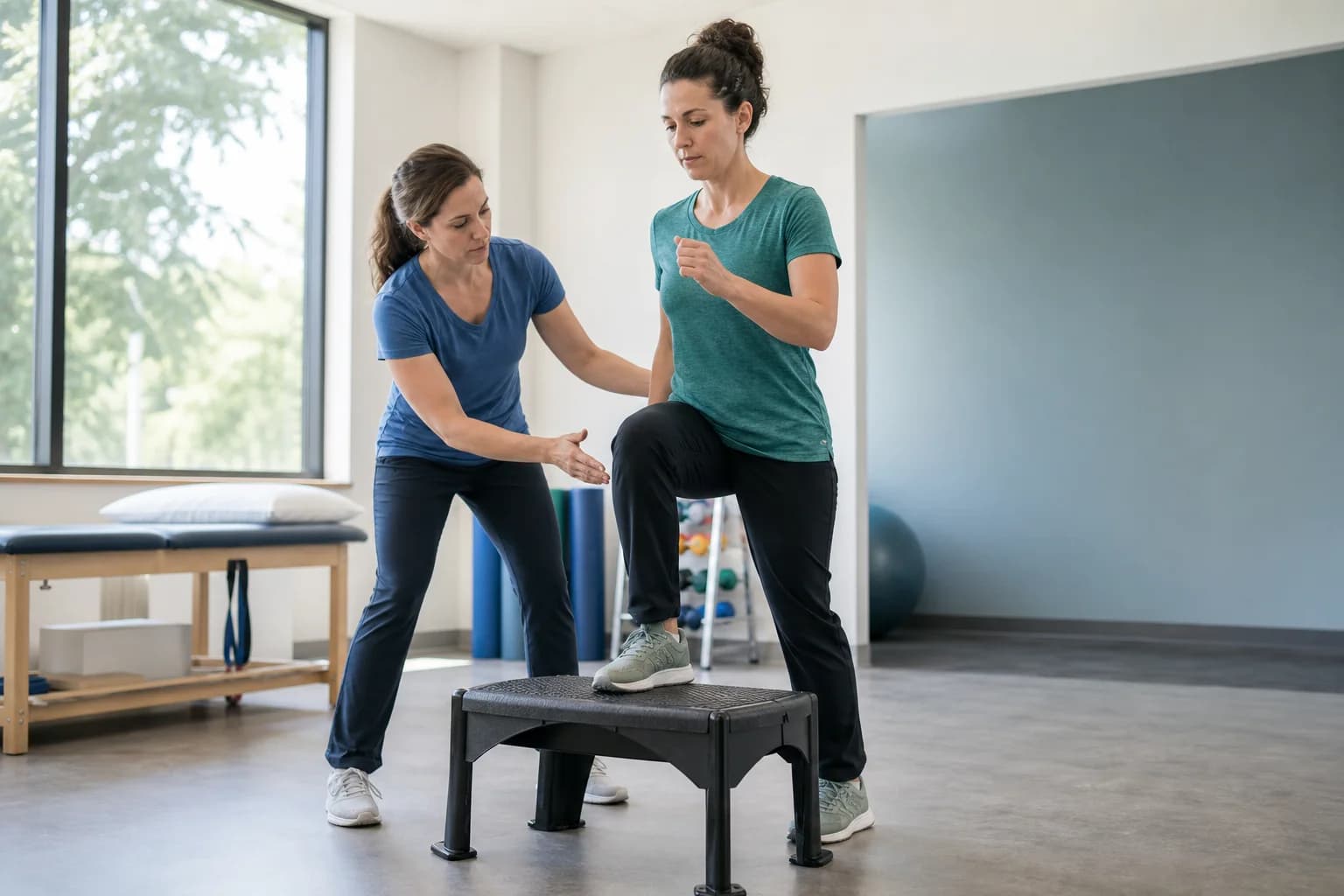
2. Controlled step-ups Use a low step. Step up with purpose, pause at the top, then step down slowly. Keep the knee tracking over the middle toes. Start low and prioritize control over height.
3. Medicine ball chest pass or wall push For upper-body power without joint pounding, use a light medicine ball chest pass to a wall or a faster push from the hands into a wall. Keep the ribs down and shoulders relaxed.
4. Fast-up, slow-down heel raises Rise onto the balls of your feet a little more quickly, then lower slowly. Hold a counter for balance. This supports calf capacity, ankle control, and walking efficiency.
How much is enough?
For many adults, one to two short power-focused sessions per week is a great start, especially when layered into an existing strength routine. Keep the volume modest: 2 to 3 exercises, 2 to 3 sets, and enough rest so each rep stays sharp. Power work should feel alert and athletic, not grinding.
If you have osteoporosis, a recent surgery, joint replacement, dizziness, balance problems, or a history of falls, get individualized guidance before adding faster movements. The right version of power training may still be appropriate, but the entry point matters.
The takeaway
Joint longevity is not only about preserving range of motion or building slow strength. It is also about maintaining the ability to respond, adapt, and move confidently when life speeds up. Safe power training can help adults stay capable on stairs, trails, curbs, and busy days when movement is unpredictable.
If you are unsure which exercises are safe for your knees, hips, back, or shoulders, a physical therapy assessment can help you build a plan that improves strength, balance, and confidence without flaring symptoms. To work with a physical therapist on a plan built around your goals, visit physicaltherapy365.com to book an appointment.
References
- American College of Sports Medicine. Exercise and physical activity for older adults. Med Sci Sports Exerc. 2009. https://pubmed.ncbi.nlm.nih.gov/19516148/
- Orr R, et al. The effects of power training on balance and fall prevention in older adults: a systematic review. https://pubmed.ncbi.nlm.nih.gov/23168372/
- U.S. Department of Health and Human Services. Physical Activity Guidelines for Americans, 2nd edition. https://health.gov/our-work/nutrition-physical-activity/physical-activity-guidelines/current-guidelines
- Metter EJ, et al. Age-associated loss of power and strength in the upper extremities in women and men. https://pubmed.ncbi.nlm.nih.gov/12145004/
Clinical References
- American College of Sports Medicine position stand. Exercise and physical activity for older adults
- The effects of power training on balance and fall prevention in older adults: a systematic review
- Physical Activity Guidelines for Americans, 2nd edition
- Age-related changes in muscle power: implications for mobility and function
Related Headlines
Continue With PT365
Browse direct answers to common patient questions, learn how mobile outpatient physical therapy works, or request an appointment.